Holodomor Heroes

Holodomor Heroes

When teaching and learning about serious events in history like the Holodomor, genocide, and other crimes against humanity, it’s easy to focus on dates and facts—while losing sight of the human stories behind them. History is not only shaped by what happened, but also by those dared to speak out in the face of overwhelming adversity. Behind every fact is a real person who lived through those times—and some used their voices to share the truth with the world.

Holodomor Heroes is a collection of authoritative, easy-to-understand fact sheets based on the “5Ws” of journalism—Who, What, When, Where, and Why—offering profiles of the brave individuals who witnessed the Holodomor and risked everything to expose the truth.

These individuals were not mere bystanders—they were truth-tellers. Confronted with censorship, danger, and denial, they wrote, reported, acted to help and to warn the world about what was happening. Their words and actions broke through the silence illuminating the injustices and gave a voice to the millions who were suffering slow starvation in secret. These were ordinary people who chose to act with extraordinary bravery—bearing witness even at great personal risk.

By learning about these heroes who made a difference, we are reminded of the power of speaking out—especially during hard times. Their stories of courage teach us that even in an era of fear and repression, one can choose to act with courage and integrity. One person’s voice is a powerful act of resistance that can make a difference and help change the world.


SERIES 1: Truth Tellers – The first journalists to write about the Holodomor

Journalism has the power to uncover the truth, exposing government actions hidden behind secrecy and shedding light on the lives of ordinary people affected by world-changing events like the Holodomor. This series highlights three early journalists who bravely reported on the man-made famine while Stalin’s Soviet regime denied its existence and spread disinformation about it.

These fact sheets serve as educational tools for students and educators, offering a quick and accurate overview of each journalist’s work on the Holodomor. They highlight key details, quotes, articles, and resources, and are designed for comparative group work or as background material for further study.


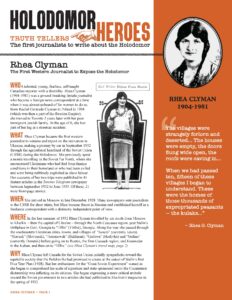
Rhea Clyman

Rhea Clyman

The First Western Journalist to Expose the Holodomor.
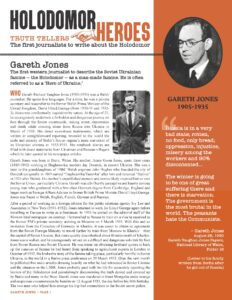
 

Gareth Jones – The first western journalist to describe the Holodomor as a planned

Gareth Jones

The first western journalist to describe the Soviet Ukrainian famine — the Holodomor — as a man-made famine. He is often referred to as a ‘Hero of Ukraine.’


Malcolm Muggeridge – The first western journalist through whose eyewitness reportage the UK first learned about the Holodomor genocide

Malcolm Muggeridge

The first western journalist through whose eyewitness reportage the UK first learned about the Holodomor genocide.


While You Read: Think About…

  • Who is this journalist, and what made them take action?
  • What risks did they face by reporting the truth?
  • When and where did they witness the Holodomor, and how did it impact them?
  • Why do you think they chose to speak out when others stayed silent?
  • How did their reporting help the world understand what was happening?

Optional Activities:

  1. Hero Reflection Journal
    Write a short journal entry from the perspective of the journalist you read about. What might they have been feeling as they reported on the Holodomor?
  2. Then & Now Comparison
    Compare the journalist’s actions during the Holodomor to a modern-day journalist or whistleblower. What similarities or differences do you see?
  3. Speak Truth Poster
    Create a poster or digital graphic that highlights a quote or action from one of the Holodomor Heroes. Explain why you think their voice mattered.
  4. Class Discussion or Debate
    Should people always speak out when they witness injustice—even if it’s dangerous? Why or why not?